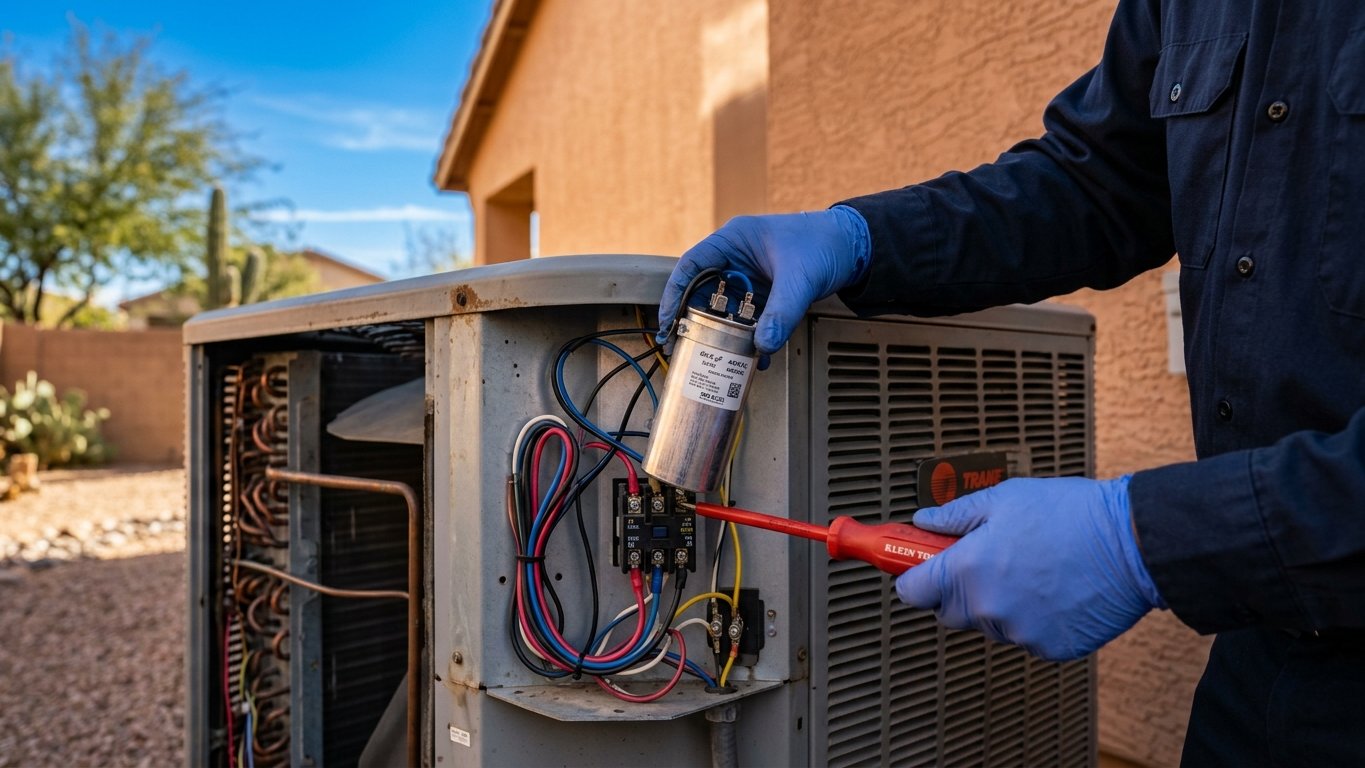
A failed capacitor is one of the most common reasons a Tucson air conditioner suddenly stops cooling, and it is also one of the quickest and most affordable repairs when caught in time. Capacitors are small cylindrical components that store an electrical charge and release it to start and run the motors in your system, including the outdoor fan motor and the compressor. They do demanding work, and they do it in punishing conditions. Our extreme, prolonged heat is exactly what wears them out, which is why capacitor failure spikes every cooling season across the valley.
Why capacitors fail constantly in our climate
Heat is the enemy of every capacitor. Inside the sealed can is a material that gradually degrades with high temperatures, and Tucson delivers high temperatures in abundance for months at a stretch. The outdoor unit, where the run capacitor lives, bakes in direct sun and radiates additional heat from its own operation, pushing internal temperatures even higher than the air around it. Under that constant thermal stress, a capacitor slowly loses its ability to hold the proper charge until it can no longer deliver the jolt the motors need. This is normal wear, not a sign you did anything wrong, but it does mean capacitors are essentially consumable parts in a desert climate and tend to fail far sooner here than in milder regions.
Recognizing the symptoms of a dying capacitor
The signs are usually distinctive once you know them. The most common is a humming or buzzing outdoor unit while the fan blade sits perfectly still, often because the run capacitor can no longer start the fan motor. You might hear a repeated clicking as the system tries and fails to start, or the unit may simply not turn on at all. Intermittent cooling, where the system works for a while and then quits, can also point to a capacitor on its way out. A weak capacitor frequently shows up as hard starting too, where the equipment strains before kicking on. If you have safe visual access to the component, a healthy capacitor has a flat top, while a failed one often bulges or domes upward as the internal materials break down under pressure.
It is worth knowing that many air conditioners use a dual run capacitor, a single component that serves both the outdoor fan motor and the compressor. When that one part weakens, you can see symptoms from either or both at once: the fan may struggle while the compressor still runs, the compressor may fail to start while the fan spins freely, or the whole unit may go quiet. This is part of why a humming unit deserves prompt attention rather than repeated breaker resets. As the capacitor fades, it forces the motors it serves to draw extra current and strain to start, and that added stress can shorten the life of far more expensive parts. Catching the failure early often means a single small part is all that needs replacing.
Why this is not a do-it-yourself repair
It is worth being blunt about the danger here. A capacitor is designed to store electrical energy, and it can hold a substantial charge long after the power to the unit is switched off. Touching the terminals of a charged capacitor can deliver a severe or even fatal shock, which is why technicians use an insulated tool to safely discharge it before handling. There is more to a correct replacement than swapping a part, as well. The new capacitor must match the original’s microfarad rating and voltage, and the wiring must be reconnected to the right terminals; getting either wrong can leave the system inoperable or damage the very motors the capacitor is meant to protect. This is a fast and inexpensive job for a trained technician, and a genuinely hazardous one for a homeowner. Whenever electrical components are involved, air conditioning repair across Tucson is work best left to professionals.
How we replace a failed capacitor
When our technician arrives, the first step is confirming the capacitor is actually the problem, since a humming unit can also stem from a contactor, motor, or wiring issue. We test the capacitor against its rated specification to verify it has lost capacitance, then safely discharge it before removing it. We install a correctly matched replacement, confirm the wiring is sound, and restart the system to verify the fan spins freely and the compressor engages cleanly. Because capacitors fail so predictably in our heat, we keep the common ratings stocked, so most of these repairs are completed in a single visit and your home is cooling again before we leave. Because a fading capacitor is one of the electrical parts a technician evaluates during routine air conditioner maintenance, a seasonal tune-up is often what catches it before it strands you.
Catching weak capacitors before they strand you
The good news about capacitors is that their decline is measurable before they fail completely. During a seasonal tune-up, a technician can test the capacitor’s remaining capacitance and flag one that has weakened but not yet quit, letting you replace it on a planned visit instead of during a no-cool emergency on the hottest day of the year. Because a weak capacitor also forces the compressor and fan motor to work harder to start, replacing it proactively protects those far more expensive components from premature wear. Pairing routine maintenance with prompt attention to early symptoms is the most reliable way to keep a small, cheap part from cascading into a major breakdown.
Call us if your unit is humming, clicking, or refusing to start, and we will test the capacitor and get you cooling again fast.