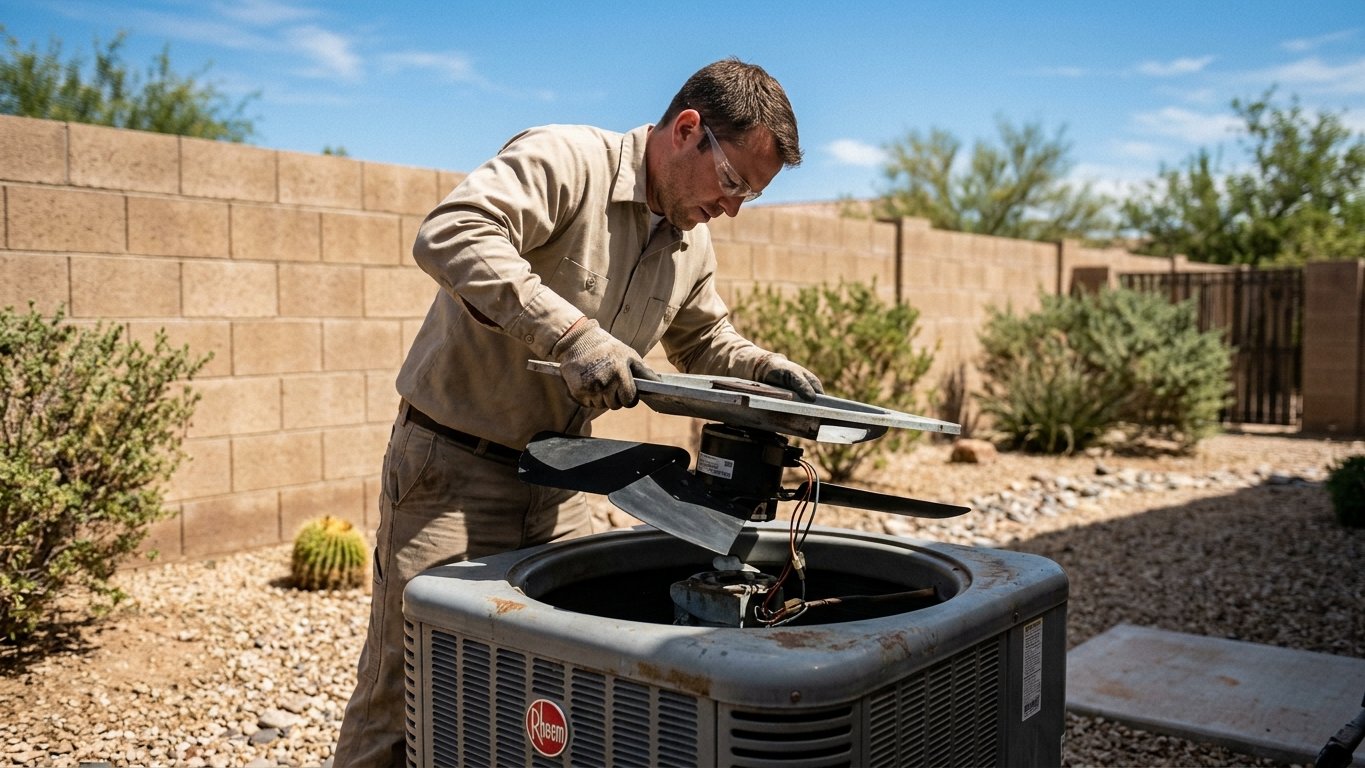
When your air conditioner hums or runs but no air reaches the registers, a failed fan motor is one of the most likely causes — and in Tucson’s relentless summer heat it is also one of the most damaging to ignore. Every cooling system relies on two motors moving air: the outdoor condenser fan that sheds heat from the refrigerant, and the indoor blower that pushes conditioned air through your ducts. When either one quits, the rest of the system keeps straining against a load it can no longer handle. Our fan motor repair service finds which motor failed, why it failed, and gets cool air moving again before the heat forces an emergency.
How a failing fan motor shows itself
The symptoms vary depending on which motor is involved, but a few patterns repeat. The outdoor unit may hum loudly while the fan blade sits still, or the blade may spin slowly and stop. Indoors, you might feel weak airflow at the vents, or no air at all even though the thermostat calls for cooling. Grinding, squealing, or rattling noises point to worn bearings. Repeated mid-afternoon shutdowns are another tell: when a motor cannot move enough air, the system overheats and trips a high-pressure or thermal safety, then restarts once it cools, only to fail again in the next heat of the day.
How we diagnose the real cause
A stalled fan is a symptom, not a diagnosis, so a methodical check matters. Our technician first confirms the motor is receiving power, then tests the run capacitor that gives the motor the torque it needs to start. A weak capacitor — extremely common in our climate, where summer heat cooks these components — will let a motor hum without ever spinning up. From there we check the motor windings for shorts or open circuits, spin the shaft by hand to feel for seized or dragging bearings, and inspect the blade and mount for physical damage. Only after that do we decide whether the fix is a capacitor, a motor, or related controls.
Choosing between repair and replacement
Not every fan problem requires a new motor. If the capacitor is the culprit, replacing that inexpensive part restores normal operation. If the bearings are merely dry, the issue is usually the motor itself rather than something rebuildable in the field. When the motor windings have failed or the bearings have seized, replacement is the honest answer, and we match the new motor to your system’s specifications. This is also where the difference between motor types matters: older PSC (permanent split capacitor) motors are simpler and depend on that external capacitor, while newer ECM (electronically commutated) motors are variable-speed, more efficient, and more expensive to replace. We explain which one your system uses and what each option costs before any work begins. For broader system issues that go beyond a single motor, our team also handles expert Tucson air conditioner repair across every major component.
How we complete the repair safely
Once you approve the work, we shut the system down at the disconnect, discharge the capacitor to make the job safe, and remove the failed motor. We install the correct replacement, set the blade clearance and rotation properly, replace a tired capacitor at the same time when it makes sense, and verify the motor draws the right amperage under load. Getting the electrical match right is critical — an undersized or wrong-speed motor will run hot and fail early, which is the last thing you want heading into a Tucson July. Lubricating motors and inspecting their electrical connections are part of professional air conditioner maintenance, which is why a tired motor is often caught during a seasonal visit before it strands you in the heat.
Verifying the fix before we leave
A motor that spins is not the same as a system that cools correctly, so we confirm the full picture before closing the call. We watch the fan reach full speed, measure airflow at the vents, check that the condenser is shedding heat, and confirm the system holds temperature without tripping a safety. We also note anything trending toward trouble, such as a marginal capacitor on the other motor or early bearing noise, so you can plan ahead rather than face another breakdown.
Preventing the next motor failure
Fan motors rarely fail without warning, and most of those warnings are easy to miss until the house stops cooling. Heat is the enemy: a dirty condenser coil makes the outdoor fan work harder, a clogged filter strains the blower, and a weak capacitor quietly overloads the motor every time it starts. Keeping coils clean, filters fresh, and capacitors tested during seasonal service is the most effective way to extend motor life in our climate. When a motor does reach the end of its run, catching the early noise or the first overheating shutdown often turns a major failure into a smaller, planned repair.
Call us the moment your fan stops moving air — running an AC against a stalled motor in Tucson heat only makes the eventual repair larger.