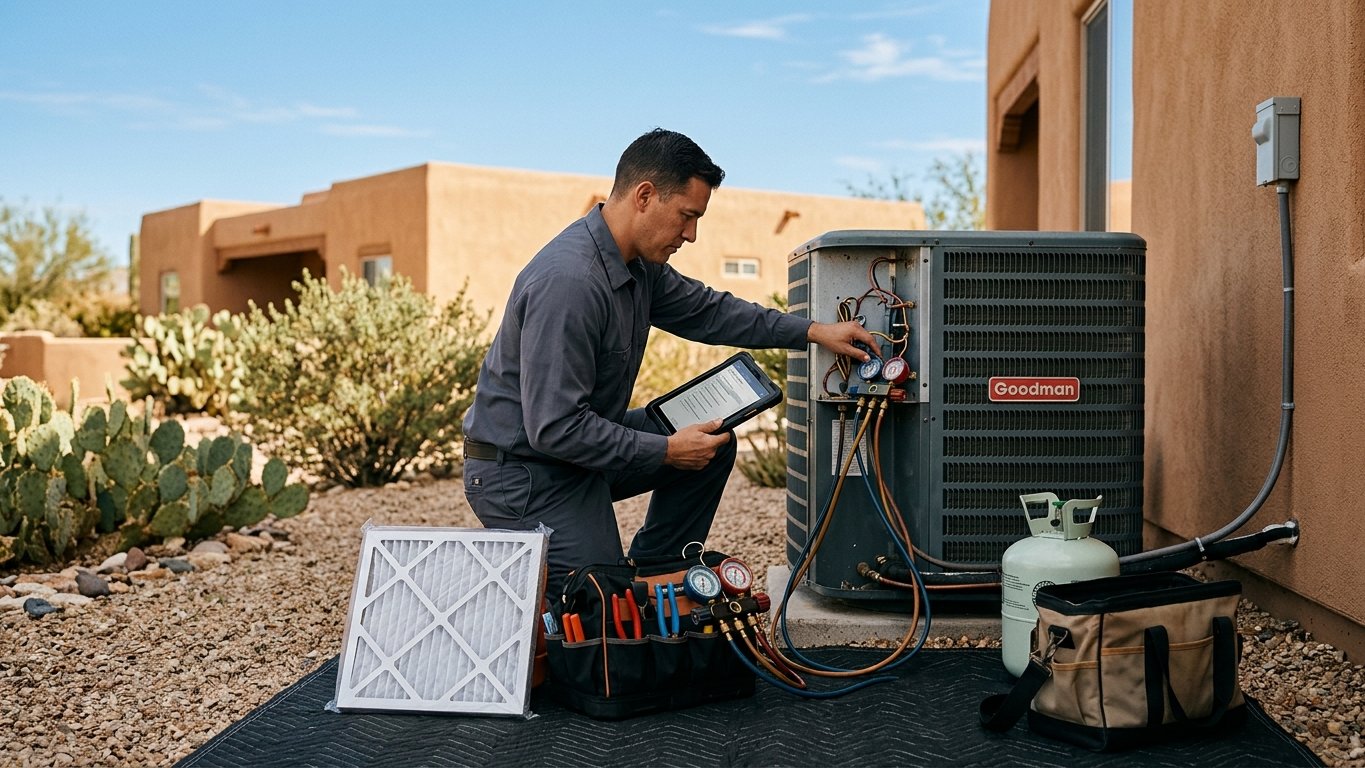
A tune-up is the cheapest cooling work you will ever pay for, because nearly everything it catches is a problem that grows more expensive the longer it goes unnoticed. In Tucson, where the air conditioner runs hard for the better part of half the year, a neglected system does not coast — it degrades, loses efficiency, and eventually fails on the hottest day it can find. Seasonal maintenance reverses that drift. It restores airflow and efficiency, surfaces small faults while they are still small, and gives you a clear picture of how much life your equipment has left before you are forced to make a decision in a crisis.
What a thorough tune-up actually includes
A real tune-up is far more than swapping a filter. Our technician replaces or cleans the air filter, then inspects and cleans both the evaporator and condenser coils, since coils caked in Tucson dust force the system to work harder for less cooling. We check the refrigerant charge and look for signs of a leak, test the run capacitor and electrical connections for the heat-related wear that is so common here, clear and flush the condensate drain line to head off clogs, measure airflow across the system, and confirm the thermostat is reading and calling correctly. The U.S. Department of Energy publishes the DOE air conditioner maintenance checklist that mirrors many of these same steps, and our service follows that same logic of inspection, cleaning, and verification.
Why Tucson homes need service twice a year
In a mild climate, an annual check is often enough. Tucson is not a mild climate. Our cooling season stretches from spring well into fall, and the equipment endures hundreds of hours of runtime at extreme temperatures, plus a relentless load of fine desert dust. That dust settles on coils and clogs filters faster than in most of the country, and the sustained heat ages capacitors and motors prematurely. A spring tune-up prepares the system for the summer assault, and a fall visit catches whatever the summer wore down before it becomes next year’s emergency. The team behind our Tucson AC repair and service team sees the difference clearly: maintained systems break down far less often than neglected ones.
How maintenance protects efficiency and lifespan
Every layer of dust on a coil and every degree of low refrigerant charge makes your system run longer to reach the same temperature, which shows up directly on your summer power bill. A clean, correctly charged, well-adjusted system moves heat efficiently and cycles the way the manufacturer intended. That efficiency is not just about cost — it is about wear. A system that struggles runs longer and hotter, and that extra runtime ages every component faster. Consistent maintenance keeps the equipment operating in its designed range, which is the single most reliable way to push its useful lifespan toward the upper end rather than the lower.
How a tune-up prevents emergencies
The value of maintenance is mostly invisible, because its job is to stop things from happening. A capacitor reading low gets replaced before it fails on a 108-degree afternoon. A coil starting to clog gets cleaned before it freezes over. A drain line beginning to collect algae gets flushed before it backs up and trips a safety switch. Each of these is a routine, planned fix during a tune-up — and each is a frantic, after-hours no-cooling call if left alone. Maintenance trades a small, scheduled cost for protection against the worst possible timing.
The timing of failures is what makes this matter so much in Tucson. Equipment almost never quits on a mild day with light demand; it quits during a heat wave, when the system is running flat out and every part is under maximum stress. That is also exactly when service demand spikes and a same-day appointment is hardest to get. A tune-up shifts the discovery of a weak part from that worst possible moment to a calm spring or fall visit, when the fix is simple and the house is still comfortable. You are not just preventing a breakdown — you are choosing when you deal with it.
When to schedule and what to expect
Spring is the time to act, ideally before the first stretch of triple-digit days. Booking in March or April means any weak component is found and corrected while the weather is still forgiving and before service demand peaks across the valley. During the visit, expect the technician to walk you through what was inspected, what was cleaned, and any findings — clearly distinguishing between something that needs attention now and something simply worth watching. You should leave the appointment knowing the condition of your system and what, if anything, to plan for. That clarity is as much a part of the service as the wrench work itself.
A well-documented maintenance history also helps you make smarter decisions down the road. When you can see that a system has been serviced consistently and is still struggling, the case for replacement becomes clear and unhurried rather than forced by a sudden failure. Maintenance records can matter for warranty coverage as well, since many manufacturers expect regular professional service to keep their terms intact.
Call to schedule your tune-up before the Tucson heat arrives — a little attention in spring is what keeps your system reliable through the long summer ahead.