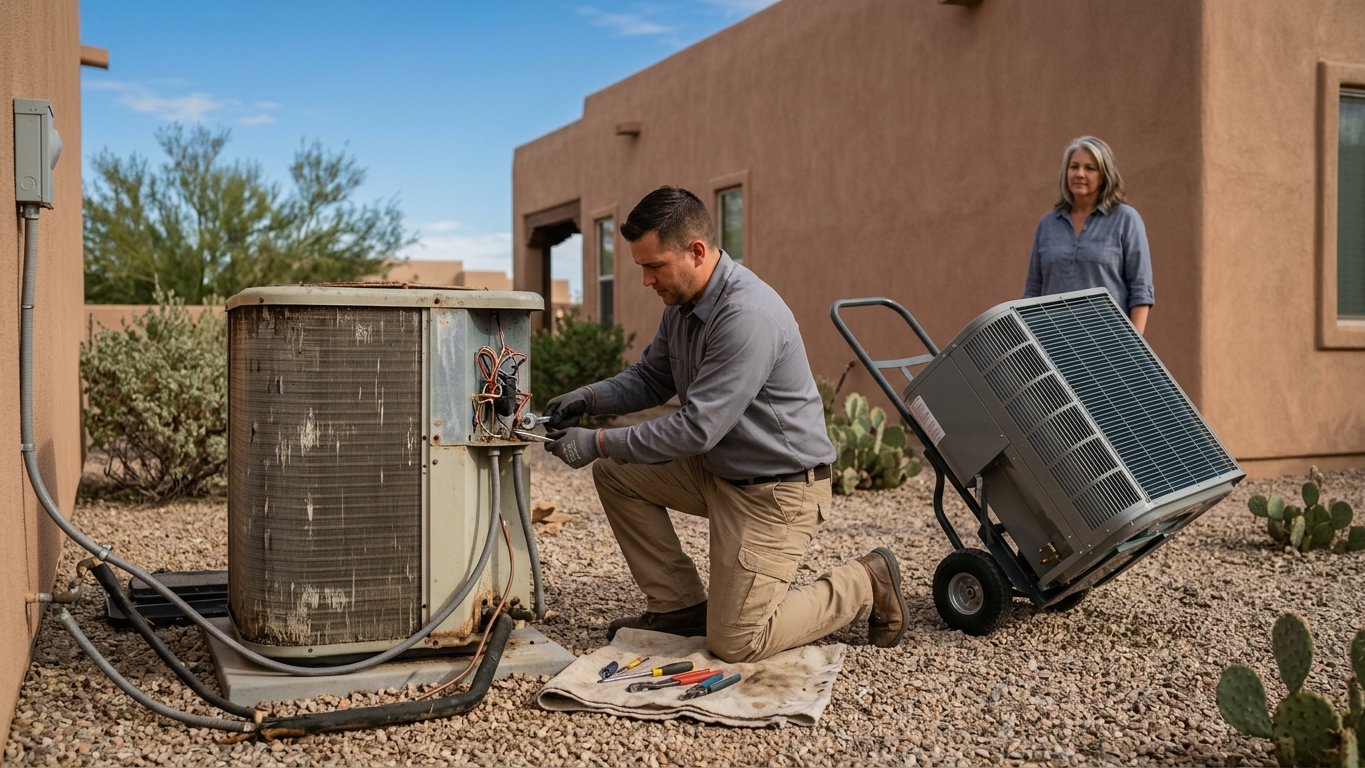
When an air conditioner reaches the end of its useful life in Tucson, the decision to replace it carries real weight — both for your summer comfort and your budget. We help homeowners across Tucson make that call with clear information rather than pressure, and when replacement is the right move, we install a system sized and matched to the home. The goal is a quieter, more efficient air conditioner that you do not have to think about for years.
The signs that point toward replacement
A few patterns reliably signal that a system is nearing the end. Age is the first: most residential air conditioners give roughly a dozen to fifteen years of dependable service, and our long cooling season tends to push units toward the lower end of that range. Repeated repairs in consecutive seasons, steadily climbing energy bills despite normal use, and uneven cooling are all clues that the equipment is losing its grip. Two issues raise the flag faster than the rest — a compressor failure and a system still charged with phased-out R-22 refrigerant, which is increasingly costly and harder to source.
The repair-versus-replace math, laid out honestly
Every aging system reaches a tipping point, and we walk you through where yours sits. The questions we weigh together are straightforward: How old is the unit? What does this specific repair cost relative to the value of the equipment? Is the refrigerant still readily available? Are the failures piling up? A capacitor or contactor on a younger, R-410A system is an easy repair. A major component failure on a unit well into its second decade is usually money better spent toward a new system. We give you the reasoning so the decision stays yours — never a scare tactic.
Refrigerant deserves its own mention here, because it increasingly pushes aging systems toward replacement. Older units charged with phased-out R-22 are costly to service, since the refrigerant itself is no longer manufactured and existing supplies command a premium. Repairing a significant leak on an R-22 system often means pouring money into a unit whose fuel source is disappearing, while a modern replacement uses current refrigerant that is widely available and supported. We will tell you plainly which refrigerant your current system runs and what that means for its remaining service prospects, so the decision rests on facts rather than guesswork.
A fresh load calculation, not a copy of the old unit
It is tempting to simply order the same tonnage as the system coming out, but that often repeats an old mistake. Many existing units were oversized at install, and homes change — added insulation, replaced windows, or new shade trees all alter the cooling demand. We run a current heat-load calculation so the replacement matches how your home behaves now, accounting for Tucson’s intense west- and south-facing sun exposure and dry air. Choosing replacement equipment is part of Tucson air conditioning installation, so the sizing and the install come from the same hands.
Matching the new system to your home and ducts
A replacement is a chance to correct more than just the equipment. We confirm the indoor and outdoor components are a matched pair so the system reaches its rated efficiency, and we inspect the existing ductwork for leaks, undersizing, or damage that would undermine a capable new unit. It is common for an older home to have accumulated small duct problems over the years — a disconnected run in the attic, crushed flex, or insulation that has slumped away — and a replacement is the right moment to find and correct them rather than seal a new system onto old faults. Deciding when to replace versus repair an aging system is a judgment call worth getting right.
It helps to weigh the mounting repair bills against the efficiency of a new central air conditioner before committing either way.
If repairs to the ducts or electrical are warranted, we quote them transparently rather than bolting a new condenser onto compromised infrastructure and hoping for the best.
Minimizing downtime in the Tucson heat
Going without cooling for long in a Tucson summer is more than an inconvenience, so we plan replacements to keep that window short. A straightforward changeout — removing the old condenser and indoor unit and installing the matched new system on existing ducts — is generally a one-day job, with the home cooling again by evening. More involved work, such as ductwork modifications or relocating equipment, can extend into a second day, and we tell you that up front. Scheduling and sequencing the job to limit the hours your home sits warm is something we treat as part of the service.
What a well-chosen replacement delivers
Done right, a replacement is not just a like-for-like swap — it is an upgrade in comfort and operating cost. A properly sized modern system runs longer, gentler cycles that hold the whole house even and pull humidity from the air, instead of the short blasts that leave hot and cold pockets. Lower energy use over Tucson’s six-plus months of cooling adds up, and a clean install protects the manufacturer warranty. The payoff is a system you can stop worrying about through the hottest stretches of the year.
Call to schedule a no-pressure replacement assessment and get the honest math for your system.