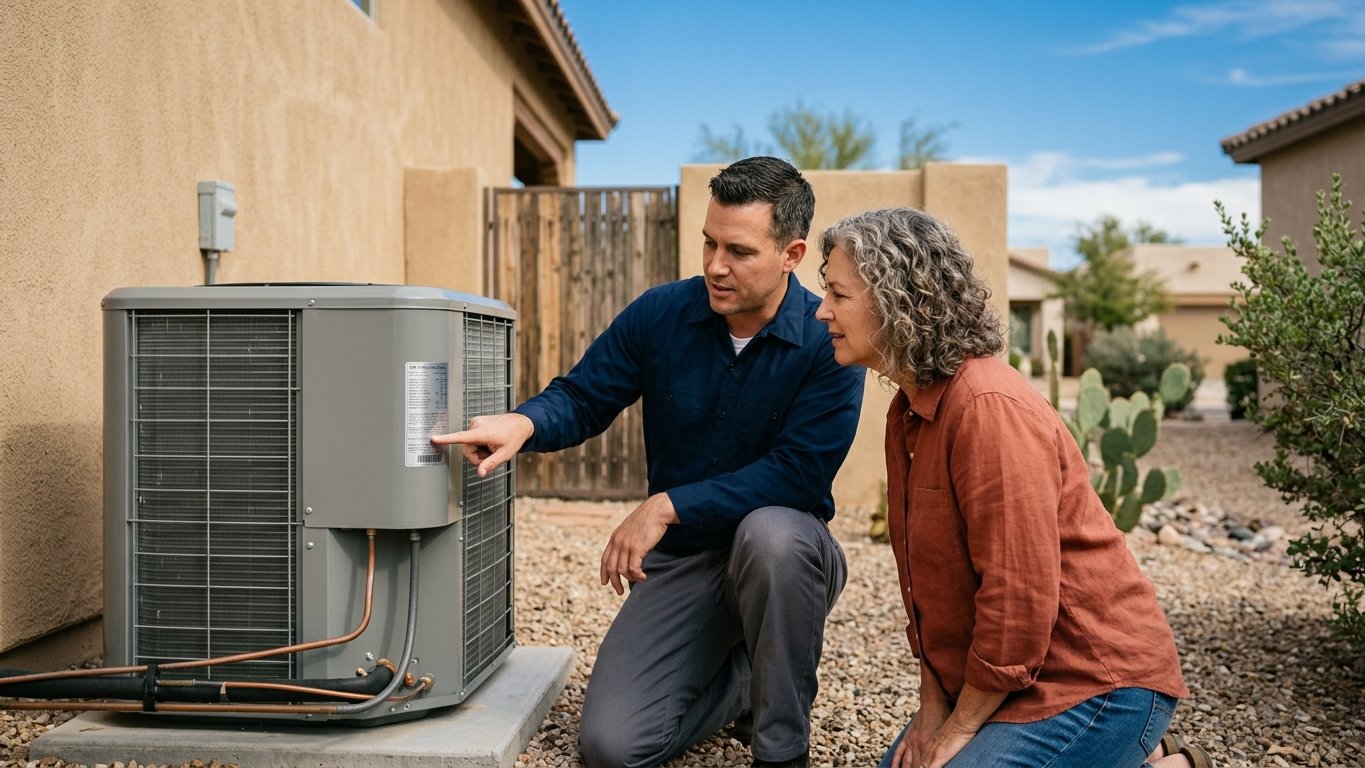
Upgrading to a more efficient air conditioner is a different decision than a routine replacement, because in Tucson the math is shaped by how long the system runs. Our cooling season stretches across the better part of the year, and every one of those runtime hours is an hour where a more efficient system spends less to do the same job. We help homeowners weigh high-efficiency upgrades with honest modeling rather than marketing, so the choice rests on real expected savings and real comfort gains — not a sales pitch.
What SEER2 actually measures
The headline number on an efficiency upgrade is SEER2, and it is worth understanding plainly. SEER2 is a seasonal efficiency rating: it expresses how much cooling a system delivers across a season relative to the electricity it consumes. A higher SEER2 means more cooling per unit of energy. Because it is a seasonal average rather than a single peak reading, it reflects how the system behaves over the long haul, not just on a test bench. The U.S. Department of Energy’s guidance on energy-efficient central air conditioning covers the same efficiency fundamentals we use to frame an upgrade.
Tucson’s long season magnifies every efficiency gain
This is the heart of why efficiency matters more here than almost anywhere. An efficiency improvement saves money only while the system is actually running — and Tucson air conditioners run a great many more hours per year than units in cooler climates. The modest per-hour savings from a higher-efficiency system get multiplied across our six-plus months of cooling, which is exactly the leverage a short summer never provides. The longer your system runs, the more an efficiency upgrade has the opportunity to pay for itself, which is why the same upgrade pencils out differently in Tucson than it would up north.
Variable-speed and two-stage systems change how the home feels
Efficiency is not only about the bill; it is about comfort. Older single-stage systems operate at one speed — full output or nothing — which produces temperature swings and leaves humidity behind. Two-stage and variable-speed systems instead run longer at lower output, holding the temperature steadier, moving air more gently and quietly, and pulling more moisture from the air along the way. The result is a home that feels consistently comfortable rather than cycling between too cold and too warm. For upgrading to efficient cooling, this is part of new cooling system installation in Tucson, so the efficient equipment is sized and commissioned by the same team.
Payback is modeled, not promised
We will not quote you a dollar figure pulled from thin air. What we do is model the expected difference: comparing the efficiency tier you are considering against your current system and its runtime, so you can see the relative savings before committing to a premium. The actual return depends on your home, your usage, and utility rates, which is why we present it as a reasoned estimate rather than a guarantee. Giving you a realistic picture — including the honest acknowledgment that higher efficiency carries a higher upfront cost — is how the decision should be made.
Rebates and incentives may reduce the upfront cost
High-efficiency equipment sometimes qualifies for utility rebates or other incentives that lower the net price of an upgrade, which can shorten the payback period further. Programs and eligibility change over time and vary by equipment, so rather than quote specific amounts we confirm what currently applies to the system you are considering at the time of your project. Factoring any available incentive into the comparison gives you the truest view of what the upgrade really costs.
Right-sizing still comes first
An efficiency rating means little if the system is the wrong size for the home. A high-SEER2 unit that is oversized still short-cycles and squanders its potential, so every efficiency upgrade starts with a fresh load calculation — measuring square footage, insulation, and Tucson’s heavy solar gain through west- and south-facing glass. Matching the indoor and outdoor components correctly and charging the system precisely is what lets it reach its rated efficiency in practice. The most efficient system on paper only delivers when it is sized, matched, and commissioned right.
Higher efficiency is also not automatically the right answer for every household — the best tier depends on how you use the home. A house occupied all day, kept cool through the whole season, has far more runtime hours over which an efficiency upgrade can earn back its premium than a home left warmer while everyone is away. Ceiling height, insulation quality, and how much west-facing glass drives the afternoon load all shape the calculation too. Rather than steer everyone toward the top tier, we match the efficiency level to your home and habits, so you are not paying for capability you will not recoup. That fit between equipment and lifestyle is what makes an upgrade genuinely worthwhile instead of just impressive on the spec sheet.
Call to talk through an efficiency upgrade and get the expected savings modeled honestly for your home.