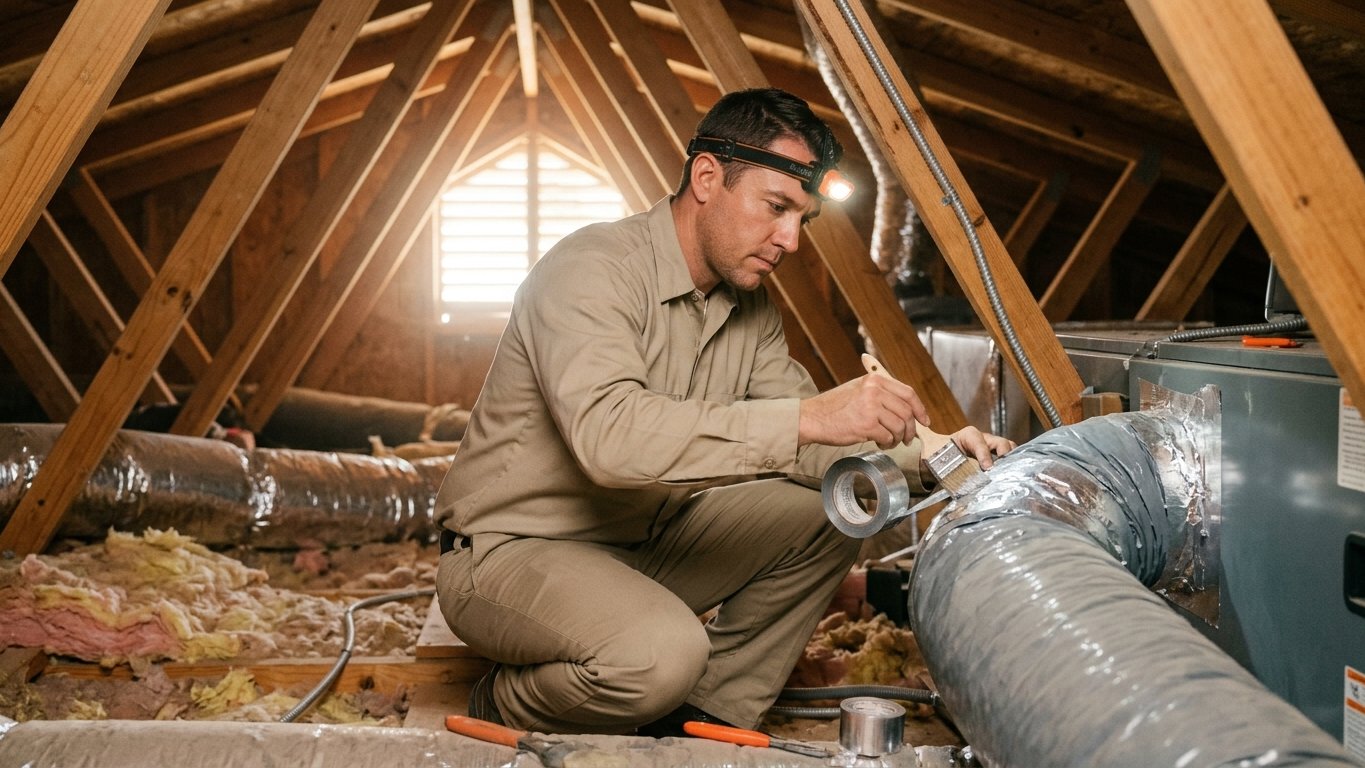
In Tucson, most of a home’s ductwork runs through the attic — and that attic can hit 130°F or more on a summer afternoon. Every gap, loose joint, and disconnected run in that ductwork leaks air. When the leaks are on the supply side, you are paying to cool your house and instead cooling the attic. When they are on the return side, the system pulls superheated, dusty attic air straight into the airflow. Sealing those leaks is one of the highest-return things you can do for comfort and efficiency in a desert home.
We seal and repair ductwork the measured way: find the leaks, fix them with materials that survive attic heat, and verify the result.
How leaky ducts cost you in the desert
Leakage in unconditioned space is uniquely expensive here. A supply leak dumps air you already paid to cool into a space you never occupy, so the system runs longer to make up the difference — driving up bills during the exact months when rates and runtime peak. A return leak is worse for comfort: it draws 130-degree attic air and fine dust into the system, so rooms feel stuffy, the filter loads up faster, and the equipment works against itself. The Department of Energy’s guidance on sealing and insulating ductwork explains how losses in ducts running through unconditioned space erode cooling performance.
The signs your ducts are losing air
A few patterns point to duct leakage. Rooms farthest from the air handler that never quite reach the thermostat setting often signal that air is escaping before it arrives. Cooling bills that climb faster than the weather explains are another flag. Weak airflow at the registers at the end of long runs, a dusty film that returns quickly after you clean, and rooms that feel uneven from one end of the house to the other all fit the same picture. None of these prove leakage on their own, which is why we test rather than guess.
Finding the leaks before sealing anything
We start with a duct pressure test combined with a hands-on inspection of accessible runs. The pressure test puts a number on total leakage; the inspection finds the specific offenders — disconnected boots, crushed flex duct, gaps at the air handler and plenum, and joints that were never sealed at installation. Mapping the leaks first means we seal where it actually matters instead of coating everything and hoping. It also gives us a baseline to measure against once the work is done.
Sealing methods that hold up in attic heat
The fix has to survive the same heat that caused it. We seal accessible joints and seams with mastic and reinforcing mesh, use metal-backed tape rated for ducts where appropriate, and reconnect or replace flex runs that have come loose or been crushed. For homes with many small leaks spread throughout the system — common in older houses with long, complex runs — an interior aerosol duct sealant can seal from the inside without tearing the attic apart. We also check that runs in the attic are properly insulated, because a sealed but uninsulated duct still gives up cooling to the heat around it. Duct sealing sits within our Tucson air duct services, so the same crew can pair it with inspection or filtration work when that is warranted.
Verifying the work paid off
Sealing is one of the few HVAC improvements you can actually measure, so we do. After the work, we retest duct pressure and compare it to the baseline reading from before, confirming the leakage dropped. You see the numbers, not just a claim that it is better. Many homeowners also notice the practical results within days — more even temperatures from room to room, stronger airflow at the far registers, and a system that cycles less to hold the same setting through a Tucson afternoon.
Call to schedule a duct pressure test and find out how much air your system is losing.