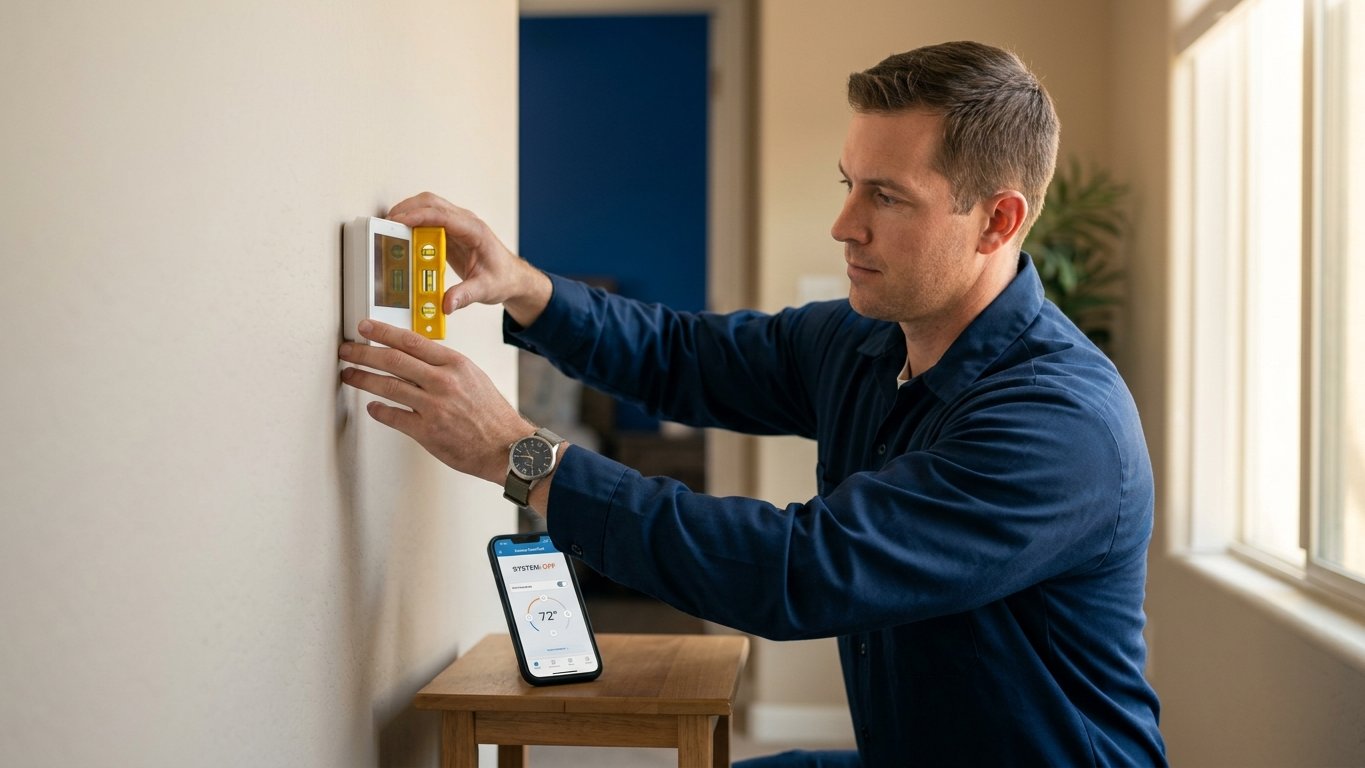
The thermostat is the smallest part of your HVAC system and the one you touch every day, so when it misbehaves the whole house feels it. A thermostat that reads the wrong temperature, loses its Wi-Fi connection, or can’t control your heat pump properly leads to uneven comfort and wasted energy across Tucson’s long cooling season. We install, set up, and repair programmable, Wi-Fi, and smart thermostats, and we make sure the one you end up with actually matches the equipment it controls.
Matching the thermostat to your equipment
Not every thermostat works with every system, and installing the wrong one is a common source of comfort complaints. A single-stage thermostat cannot properly run a two-stage furnace or a variable-speed system, and a basic model may not support the heating-and-cooling changeover a heat pump needs. We confirm whether your system is a heat pump, a conventional split system, or a multi-stage unit, then recommend a thermostat that can drive every mode it has. Getting this match right is the difference between a control that simply turns equipment on and off and one that lets the system run the way the manufacturer designed it.
Handling wiring and the C-wire question
Behind the wall, the wiring determines what a thermostat can do. Many smart and Wi-Fi models need a common (C) wire to power their displays, radios, and sensors continuously, and a lot of older Tucson homes were wired before that was standard. When the C-wire is missing, we can run a new conductor, install a compatible power adapter, or recommend a thermostat engineered to work without one. We also verify that the existing wires are correctly identified, because a mislabeled wire is a frequent cause of a thermostat that powers on but controls the wrong function.
Setting up programmable savings the right way
A programmable thermostat saves energy by easing back on conditioning when you’re asleep or away, then returning to a comfortable setting before you need it. The Department of Energy describes how programmable thermostat savings come from those scheduled setbacks rather than from the device itself. There is an important caveat for our market, though: the DOE specifically advises that setbacks are generally not recommended for heat pumps in heating mode, because pulling the temperature down too far can force inefficient backup heat to run during recovery. We set schedules that capture real savings on cooling without triggering that penalty on heating.
Diagnosing common thermostat faults
When comfort problems trace back to the thermostat, the causes are usually a short list: dead or low batteries, a tripped float switch or safety that cuts the thermostat’s power, corroded or loose wire connections, a failed temperature sensor that misreads the room, or a unit mounted where sun or a supply register skews its readings. We test the thermostat against the equipment to confirm whether the control itself failed or whether it is reporting a problem elsewhere in the system. Thermostat work is one part of our Tucson HVAC services, so if the real fault turns out to be in the air handler or wiring, the same technician can address it.
Choosing between programmable, Wi-Fi, and smart models
Thermostats fall along a spectrum, and the right one depends on how you live and what your system needs. A basic programmable thermostat lets you set a fixed schedule and is a dependable, low-cost upgrade for a predictable household. Wi-Fi models add remote control from your phone, which is genuinely useful in Tucson when you want to start cooling the house before you get home on a 105-degree afternoon. Full smart thermostats go further with features like learning schedules, occupancy sensing, and energy reports. More features only help if the thermostat also supports your equipment’s modes, so we steer the decision by both your preferences and your system’s requirements rather than by the longest feature list.
Where a thermostat lives determines how accurately it senses your home, and a poorly placed one undermines even the best equipment. Mounted in direct sun, near a supply register, above a heat-producing appliance, or on an exterior wall, a thermostat reads a temperature that doesn’t match the rooms you actually occupy, so it cycles the system at the wrong times. In Tucson, afternoon sun streaming onto a wall-mounted thermostat is a common culprit behind a system that seems to run constantly or never enough. When we install or relocate a thermostat, we choose a location on an interior wall away from those influences, and on systems that support them we can add remote sensors so the thermostat balances comfort across the rooms that matter most rather than just the hallway it hangs in.
Verifying control before we finish
Once a thermostat is installed or repaired, we run the system through each mode it supports — cooling, heating, and fan — and confirm the equipment responds correctly and the temperature reading is accurate. For smart and Wi-Fi models we connect the device to your network, set up the app, and walk you through schedules and remote control. For heat pumps we verify the changeover and recovery behavior so the control manages backup heat sensibly. The goal is a thermostat that reads the room correctly and runs your specific system the way it should, not just one that lights up on the wall.
Call to schedule thermostat installation or repair and get reliable control over your home’s comfort.