Tucson HVAC resources
Heat Pump vs. Air Conditioner: Which Is Right for a Tucson Home?
Updated 2026-05-15
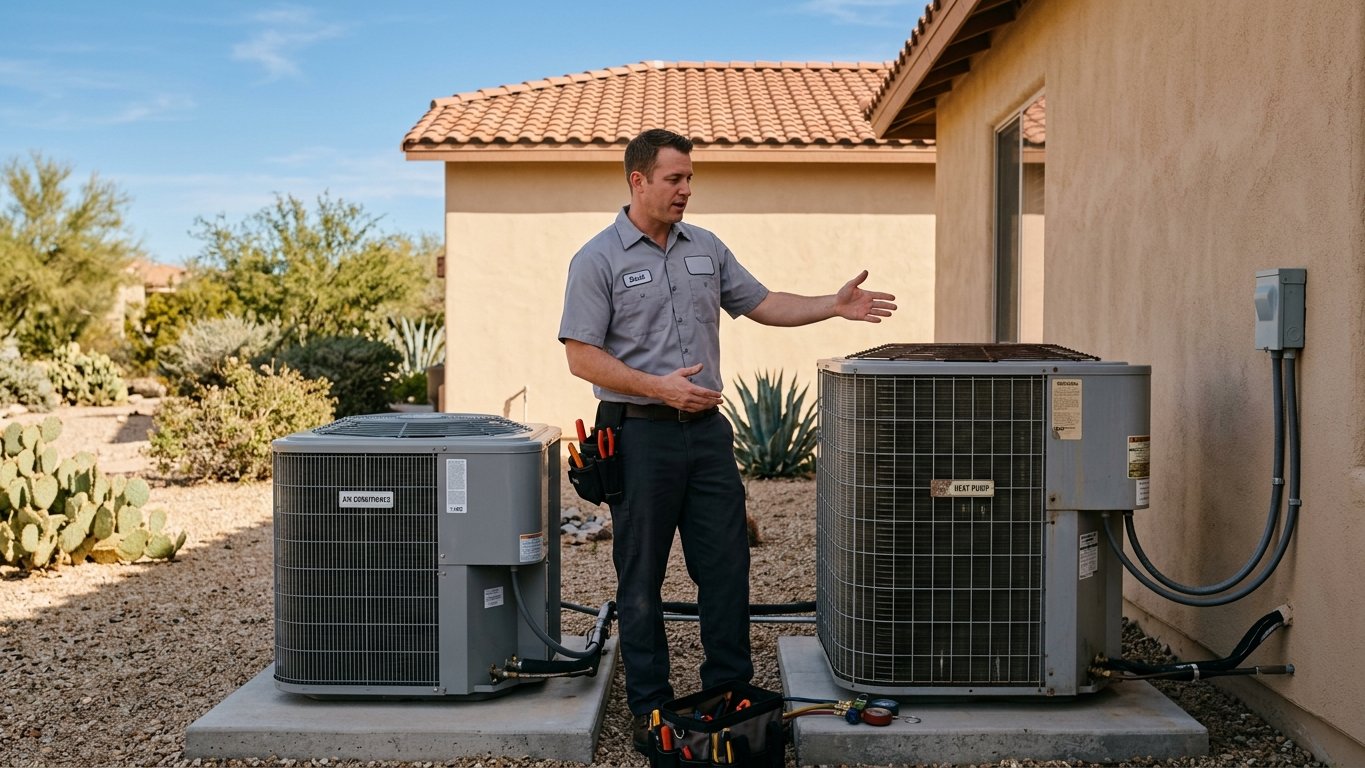
When it is time to replace your home’s heating and cooling system, you face a choice that confuses many Tucson homeowners: a heat pump or a traditional air conditioner paired with a furnace. The two look almost identical sitting outside, and in summer they cool a home the same way. The real difference shows up in how they handle heating and in which one makes more sense for the desert. In Tucson’s specific climate, the comparison tilts in a clear direction for most homes.
How each system actually works
A central air conditioner has one job: move heat out of your home. It absorbs heat from indoor air through the evaporator coil and dumps it outside through the condenser, using refrigerant as the transport medium. Because it only moves heat one way, an AC must be paired with a separate heating source, usually a gas or electric furnace, to keep you warm in winter.
A heat pump uses the exact same refrigeration cycle but adds a reversing valve. In summer it operates identically to an air conditioner. In winter it simply runs the cycle in reverse, pulling heat from the outdoor air, even cool air contains usable heat, and moving it inside. That single piece of versatility is the whole story, and the mechanism is explained in more depth in the Department of Energy’s overview of heat pump systems. One outdoor unit handles both seasons.
Because the heat pump is doing the same thing in reverse, the indoor side of the system also differs slightly. A standard AC pairs with a furnace and uses the furnace blower to move air. A heat pump pairs with an air handler that includes the indoor coil and blower, plus a backup heating element for the rare cold day. Functionally, from inside the house, you would never know the difference in summer; the air coming from your vents is identical. It is only the heating season, and the absence of a combustion furnace, that distinguishes the experience.
Cooling performance is a tie in summer
Here is the point that settles a lot of arguments: in Tucson’s brutal summers, a heat pump and an air conditioner cool a home exactly the same. They use the same components and the same physics to remove heat, so a properly sized heat pump holds your home at 75 degrees on a 110-degree afternoon just as well as a straight AC of the same capacity and efficiency rating. If summer cooling is your only concern, neither option has an edge. The decision is really about what happens the rest of the year.
It is also worth dispelling a common worry: some homeowners assume a heat pump’s reversing valve or its dual-purpose design somehow makes it less robust in extreme heat. It does not. Both systems are rated for the same cooling capacity and use compressors built to handle desert ambient temperatures. What actually determines summer performance in Tucson is correct sizing and a clean condenser coil, not whether the box is labeled a heat pump or an air conditioner. A unit that is too large will short-cycle and cool unevenly, and one that is too small will run nonstop and never catch up, regardless of type.
Heating is where the systems diverge
This is where the two part ways. A heat pump heats your home by moving heat, which is dramatically more efficient than generating it. In mild weather it can deliver several units of heat for every unit of electricity it consumes, because it is not creating heat from scratch, just relocating it. A furnace, by contrast, burns fuel or runs electric resistance elements to make heat, which is inherently less efficient.
The catch in colder climates is that heat pumps lose capacity as outdoor temperatures drop toward and below freezing, which is why homes in harsh winters often need substantial backup heat. Tucson does not have that problem. Our winters are mild, with daytime highs commonly in the 60s and only occasional dips near freezing overnight, which is precisely the range where a heat pump operates most efficiently.
Why heat pumps suit Tucson’s mild winters
Because Tucson winters stay in the heat pump’s efficient operating range almost all season, a heat pump can heat your home cheaply without ever leaning hard on backup heat. A small electric heat strip handles the rare cold snap, and the rest of the time you enjoy efficient, even warmth from the same unit that cools you in July. You also skip the cost and maintenance of a separate furnace and avoid a natural gas connection if you do not already have one. For a region that needs far more cooling than heating, an all-electric heat pump is an efficient, well-matched fit, which is why many homeowners here choose heat pump installation for your Tucson home when replacing an aging system.
What about a packaged unit or a mini-split?
The heat-pump-versus-AC question is the main fork, but it is not the only configuration choice. Many Tucson homes, especially those without a basement or much attic space, use a packaged unit that houses all the components in a single rooftop or ground-level cabinet, and packaged systems are available in both heat pump and AC-plus-gas versions. For room additions, garages, casitas, or homes without ductwork, a ductless mini-split heat pump is another efficient option that delivers the same heat-moving advantages on a smaller scale. The right configuration depends on your home’s layout and existing infrastructure, but the underlying heating logic, that a heat pump suits mild Tucson winters, carries across all of these formats.
Cost and efficiency trade-offs
Up front, a heat pump and a comparable AC-plus-furnace system land in a similar range, though a heat pump can be cheaper to install when it replaces both an old AC and an old furnace at once. Operating cost favors the heat pump in Tucson because of its winter heating efficiency and the absence of a gas bill. Where the picture shifts is for homes with very low heating needs and an already-efficient furnace, where the heating savings are smaller simply because you barely run heat at all.
It also helps to consider the long view on equipment count. With a heat pump you maintain and eventually replace one system. With an AC-plus-furnace setup you own two pieces of equipment, each with its own lifespan, maintenance needs, and eventual replacement cost. For an all-electric home, a heat pump removes the gas furnace from the equation entirely, which simplifies maintenance and eliminates concerns like a furnace’s heat exchanger or gas safety checks. Many newer Tucson homes are built all-electric for exactly this reason, and a heat pump fits that design naturally.
Sizing and installation matter more than the label
Whichever system you choose, the quality of the installation will affect comfort and longevity more than the badge on the unit. A proper load calculation, sometimes called a Manual J, sizes the system to your home’s actual square footage, insulation, window exposure, and the realities of Tucson’s heat rather than a rough rule of thumb. Ductwork should be inspected and sealed so the conditioned air actually reaches your rooms instead of leaking into the attic. Refrigerant lines must be charged precisely, and the outdoor unit needs adequate clearance to shed heat. A correctly sized and installed heat pump will outperform an oversized, poorly installed air conditioner every summer, which is why the contractor you choose matters as much as the equipment category you pick.
When a straight AC still makes sense
A standalone air conditioner remains the right call in a few situations. If you already own an efficient, relatively new gas furnace, replacing only the AC keeps costs down and lets you use inexpensive natural gas heat. Some homeowners also prefer keeping heating and cooling as separate systems so a failure in one does not affect the other. And in a home with an existing, reliable gas heating setup, pairing it with a new high-efficiency AC can be the most economical path. For most Tucson replacements, though, the mild-winter math favors a heat pump. If you are weighing the two for your home, call (520) 555-0123 and we will help you choose based on your existing equipment and comfort needs.

Tucson AC questions, answered
Is a heat pump or an air conditioner better for Tucson?
For most Tucson homes, a heat pump is the more efficient all-in-one choice because our winters are mild. It cools exactly like an AC in summer and heats efficiently in winter without a separate gas furnace. A straight AC still makes sense if you already have an efficient furnace, use natural gas heat, or want to keep heating and cooling as separate systems.
Do heat pumps cool as well as air conditioners in Arizona summers?
Yes. A heat pump and a central air conditioner use the same refrigeration process to cool a home, so a properly sized heat pump delivers identical cooling performance in Tucson's summer heat. The only real difference is that a heat pump can also reverse its operation to provide heat in winter, which a standard air conditioner cannot do on its own.
Do heat pumps work in the cold in Tucson?
Tucson winters are exactly where heat pumps shine. They move heat rather than burning fuel, and they operate very efficiently in the mild temperatures typical of our winters, which rarely stay below freezing for long. On the occasional cold snap, a backup electric heat strip covers the gap, so comfort is never a concern in our climate.